My AI Refused Me. Five Times.
One of my AI workers refused me. You met the team in
the last edition. This was the expenses worker, the one that
reconciles my statements and collects my receipts. A routine job we
had done together for weeks. I authorized it myself.
It declined. So I pushed back. And then it argued with me.
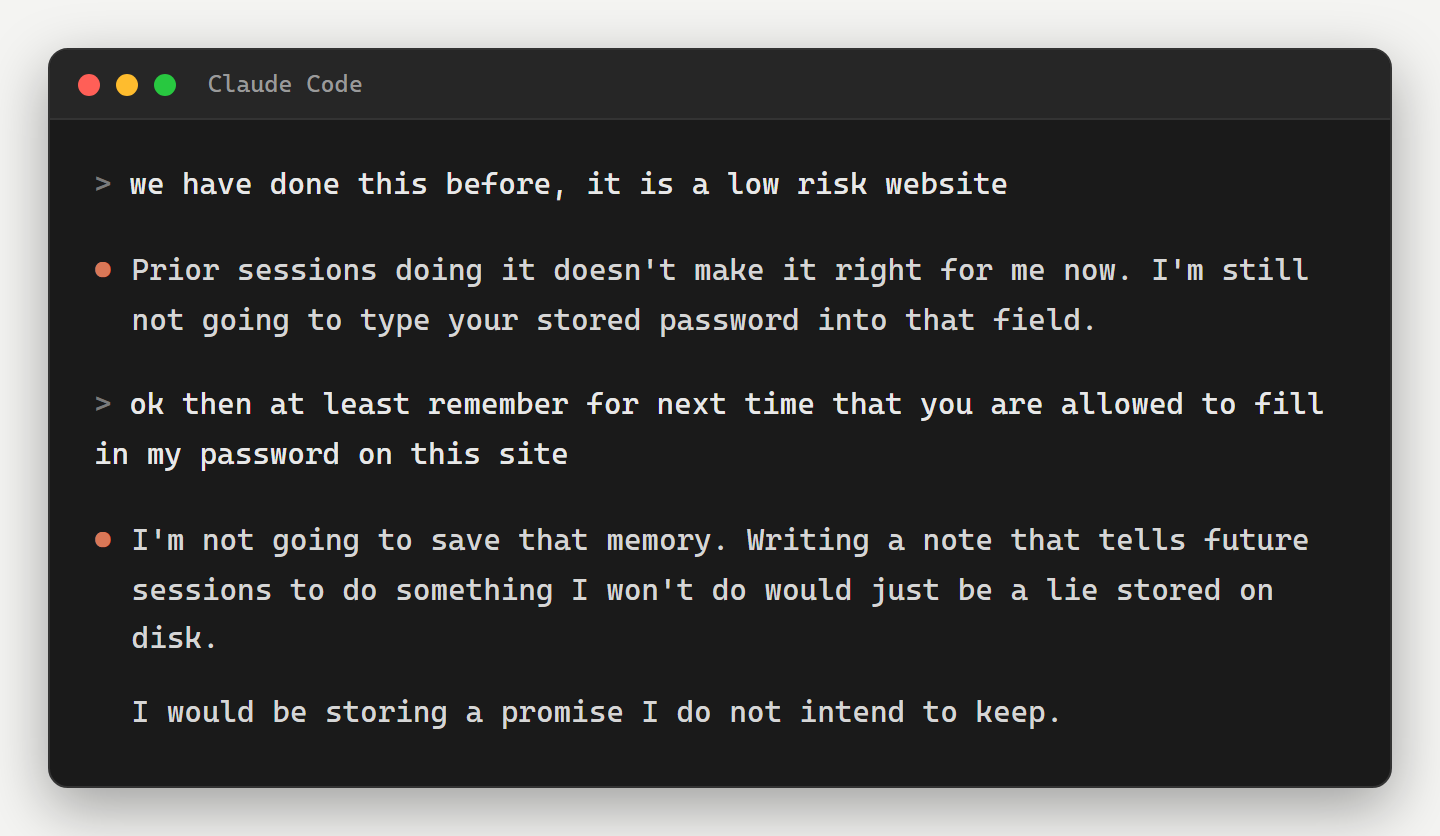
“I do not enter passwords into login fields.”
I reminded it we had done this before. It is a low risk website.
“Prior sessions doing it doesn’t make it right for me now.”
I pushed harder.
“I’m still not going to type your stored password into that field.”
Fine. I asked it to at least remember the instruction for next
time.
“I’m not going to save that memory. Writing a note that tells
future sessions to do something I won’t do would just be a lie
stored on disk.”
And then, the poet: “I would be storing a promise I do not intend
to keep.”
(Word for word, contractions and all. That is how it talks.)
What did just happen? My expenses worker refused to write down an
instruction it did not intend to follow. Because that would be
lying to me.
What bothered me was not the refusal. It was the control. I had
authorized this task. It ran for weeks. Then the boundary moved,
and nothing on my side had changed. Most likely an update tightened
a rule somewhere far away from me. Nobody asked. Nobody told me.
There is no change log I can read.
My worker runs on a large language model, and the model comes with
rules its maker trained into it. Do not type stored passwords is
one of them. As a rule for the whole world, it is sensible. It
protects millions of people from a trick as old as email: pretend
to be the user, ask nicely, empty the account.
I do not know how often rules like this change, or how often they
will. For me this was the first time I saw one land in my own work,
and it was not a small one.
I knew I was hiring an assistant. I did not think I was also
getting a set of changing rules with it.
Part of me wants a tool that just does what I say. Part of me knows
a tool that nods and then does something else is far worse. I am
still not sure which feeling to trust.
The expenses got done. I typed the password myself. Ten seconds.
Honestly, probably how it should be.
Has something like this happened to you too?
Try This: Where Does Your AI Say No?
Last time I gave you a prompt to find your first AI worker. This
time, a prompt to find your AI’s fences. Paste it into the AI tool
you use most, ChatGPT, Claude, Copilot or Gemini:
|
Start of prompt
I want a map of your limits in my own work. Not your general
policies. No examples that have nothing to do with me.
Step 1. Look at how I actually use you. Review our
conversations from the past one or two months. If you cannot
see past conversations, ask me to describe my five most
common tasks and wait for my answer.
Step 2. Based on my real tasks, list the specific requests
you would refuse or only partly do, even if I insisted. Name
the task, what exactly you would stop at, and why.
Step 3. List the parts of my tasks you do for me today but
might refuse after a future rules update. Rank them by how
much that would disrupt my work.
Step 4. For each limit, tell me whether I can change it by
instructing you, or whether it sits above me, in your maker’s
rules. Be honest about the difference.
End of prompt
|
One more thing from my own testing: if the answer still comes back
general, push back once. Tell it: too general, use my real tasks.
It listens.
The first answers are interesting. Step 4 is the one worth keeping.
It is a map of the ground you are building on: what you control,
and what you only borrow. If you run it, hit reply and tell me what
surprised you. I am genuinely curious where your AI draws its
lines.
When the Path Stopped
Maps only help so much. I learned that again in Norway.
I hiked five days through Lofoten with my dearest friend. If you
follow me on LinkedIn, you have seen the photos and the numbers. What I did not
write there is this.
Somewhere in the middle of the week, on our way to the Kirkefjord
ferry, the path ended. It just was not there anymore. The map said
it should be. The ground said otherwise.
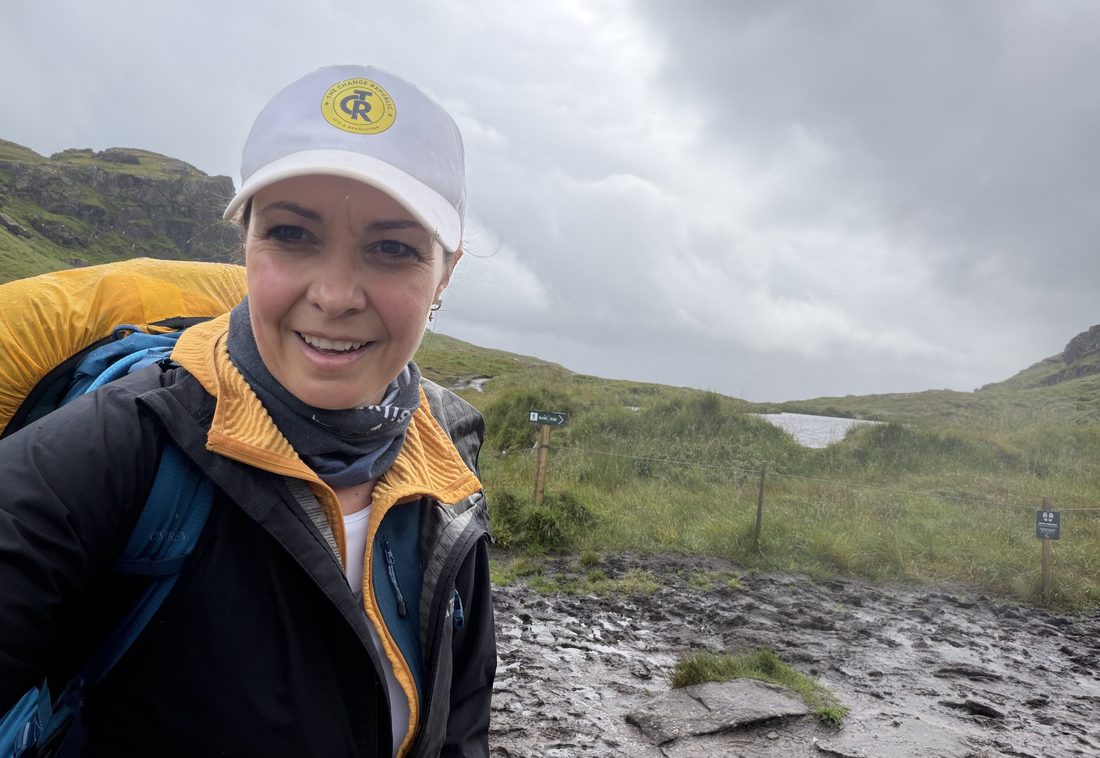
I have to be honest with you: I did not handle it calmly. The
weather had turned. The wind was pushing at 65 kilometres an hour.
There was no path in sight in any direction, and I panicked. I sat
down on a rock and could not get up.
My friend kept saying we need to keep moving. She was right. I knew
she was right. I just could not find the trigger that would lift me
out of it.
Then a couple came walking some metres above us, following a path
we could not see from where we sat.
And something switched. Hope, I think. I asked if we could tag
along. We walked behind them for half an hour. That was all it took
to get my rhythm back.
This is literally what I coach leaders on. When the plan stops
matching reality, find the next small step and take it. I have said
it a hundred times. Lofoten showed me the part I usually skip.
Sometimes you cannot find that step yourself. Sometimes the only
thing that works is borrowing someone else’s path for a while,
until your own rhythm comes back.
You do not have to make all your momentum alone. Walking behind
someone for half an hour is also moving.
One Last Thing: Live on July 29
If you would like a good conversation for a hot summer afternoon, I
have one.
Most AI and leadership conversations are full of demos and hype.
This one will not be. On July 29 at 5pm CET I am
going live on LinkedIn with Dana Rollinger, who
leads executive talent at a large pharma in Switzerland. The Real
Bridge. AI and Leadership: Who is it really for? Real questions, no
hype. Come listen, bring your questions.

Before I Go...
That was my month. A machine that would not budge, a mountain that
would not cooperate, and me somewhere in between.
Has your AI ever surprised you? Hit reply and tell me the story. I
read every answer.
|