Time to read: 5 minutes
In this edition:
-
The Code Is English
-
I Do Not Know How to Keep Up
-
From Wednesday: #OpenDoorInnovation
The Code Is English
Last time I wrote about my AI workers. My son had even asked how
many people work for me. Twenty-three, I said.
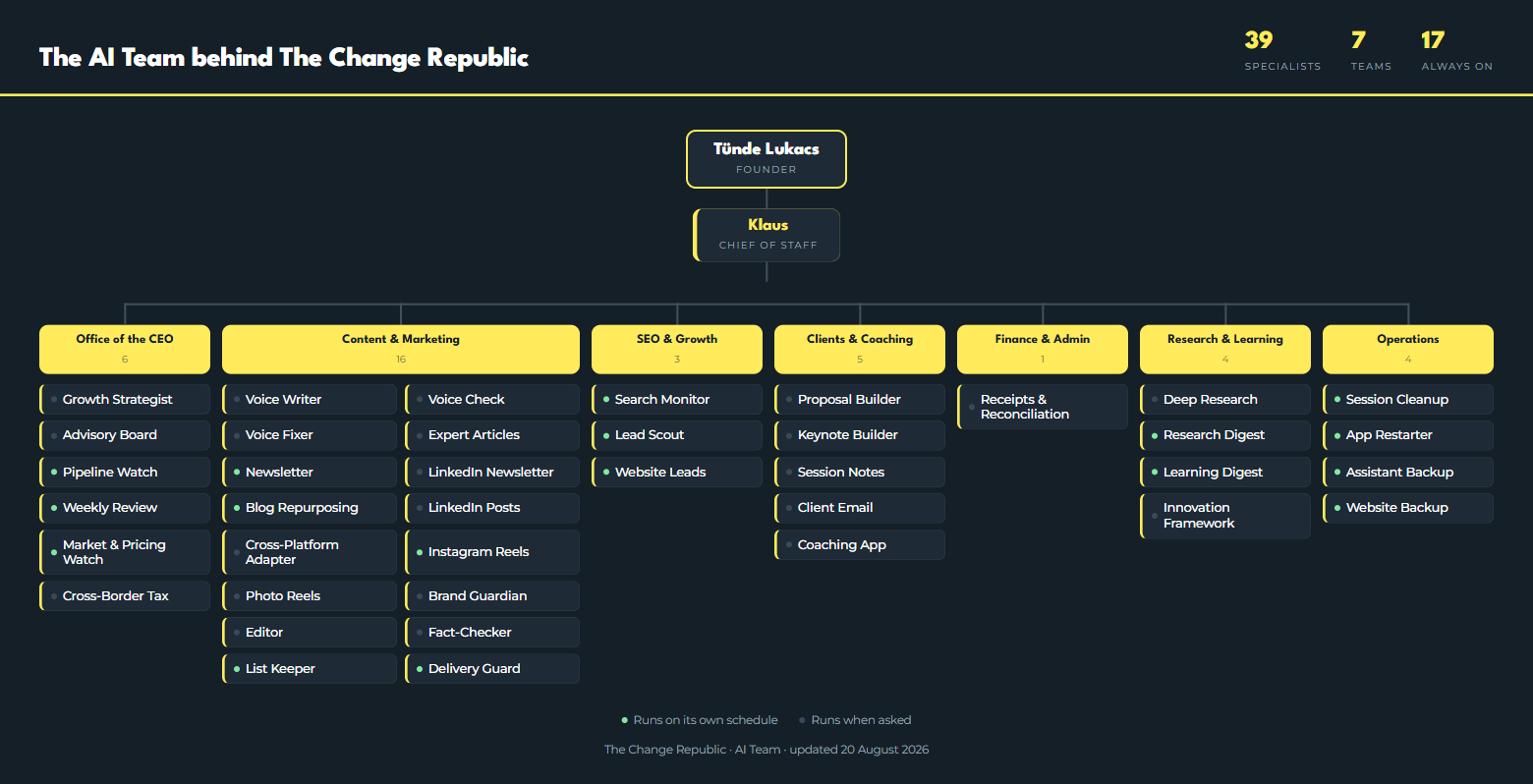
I checked the org chart this morning. Twenty-seven agents now,
plus a handful of small scheduled jobs and backups. Thirty-nine
things in total, none of them human, all of them living in my
laptop.
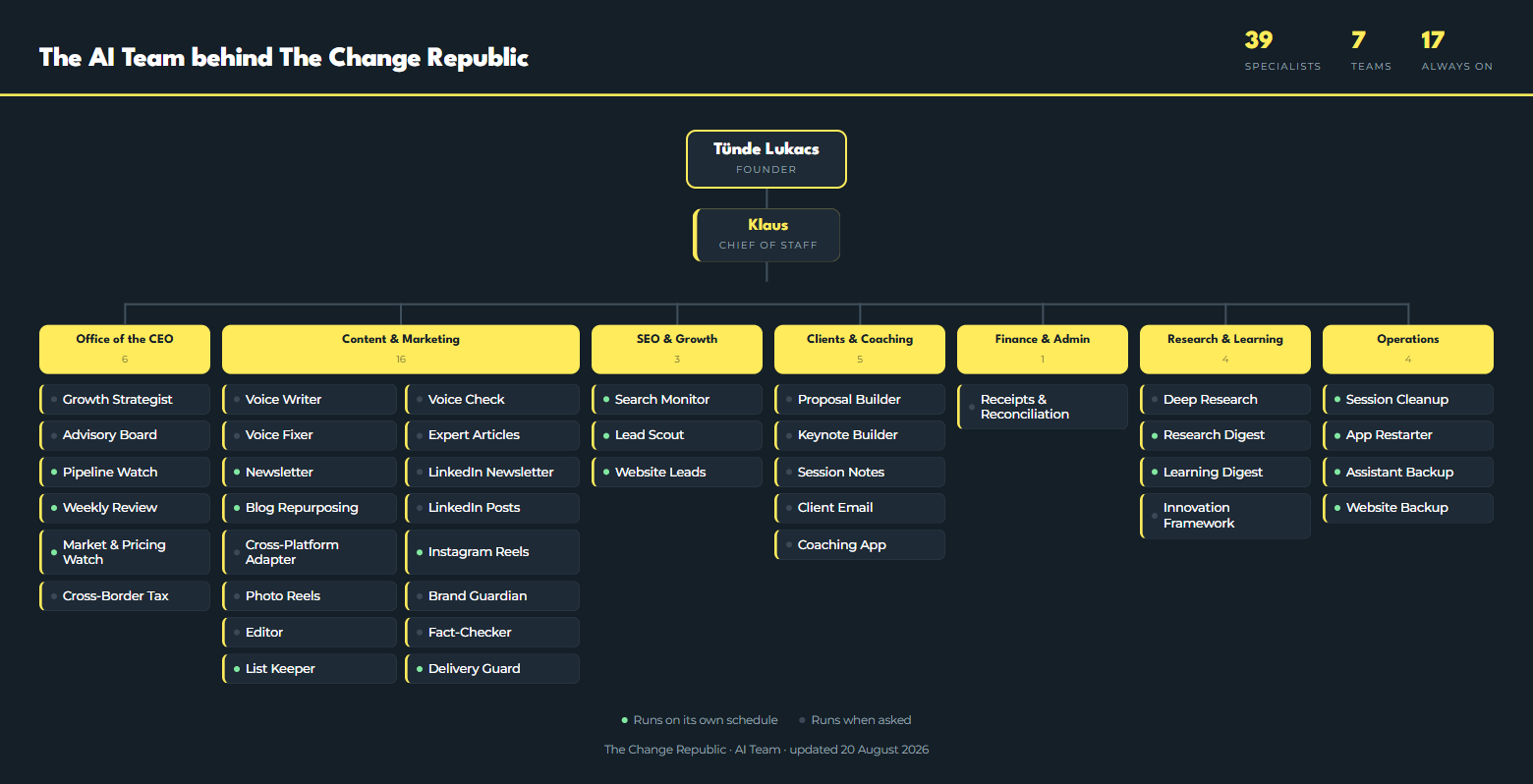
Tap the picture to see it full size.
Here is the part that surprises people.
If you opened that folder, you would not find code. You would
find text files. Plain English. Sentences I wrote.
I have never programmed. I have written instructions. These
instructions are mostly describing the pain. Like "I have all
these receipts lying in my inbox and in online platforms. My
accountant needs them matched with my credit card statement. A
screenshot of my credit card open items is in the folder I keep
for this, can you go look for the expenses? And we need to do it
every Sunday."
That is the whole trick, and I will say it slowly: you do not
really build an agent. You write down your job.
The building is not the hard part. The describing is. Most of us
have never once written down how we actually do the work we do
every day.
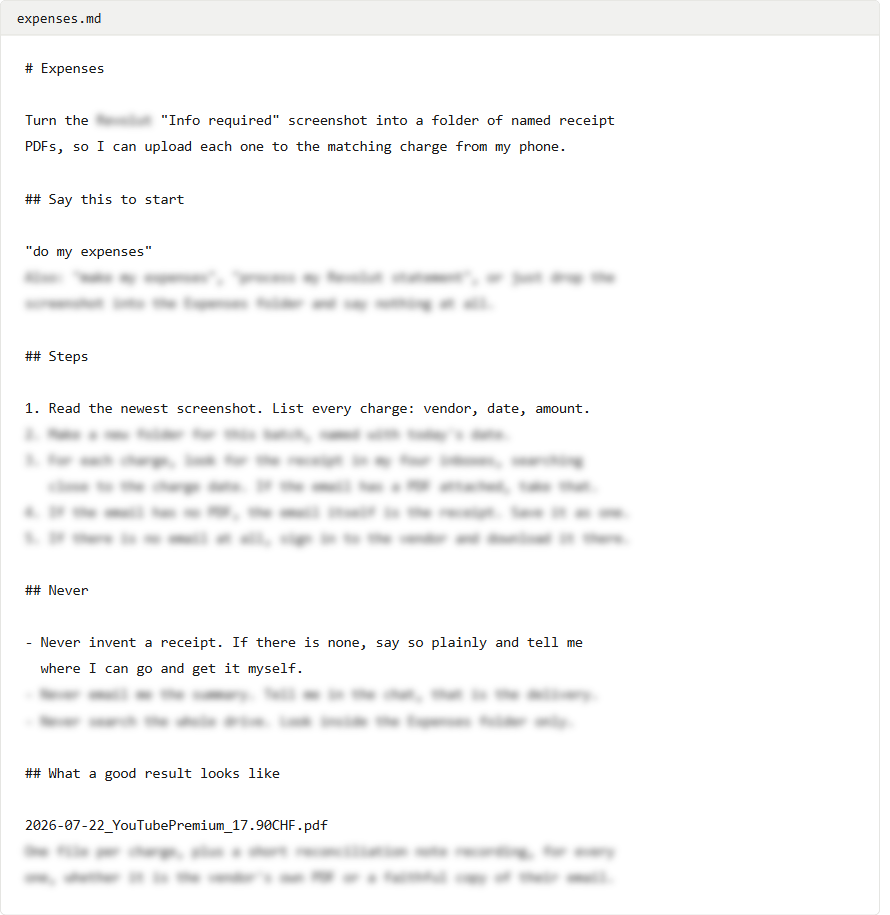
What is inside one of these files
Five things. That is really all.
-
A name and what it is for. Reconciling
expenses: find invoices all over the place and match them to my
credit card statement.
-
The words that wake it up. Start the expenses.
-
The steps, in order. Go look in the inbox, on
my SBB, EasyPark, Anthropic and other accounts.
-
The rules it must never break. It should never
forge an invoice. If it does not find one, it should tell me.
-
One example of a good result. An invoice in a
folder, with the file name showing vendor and date.
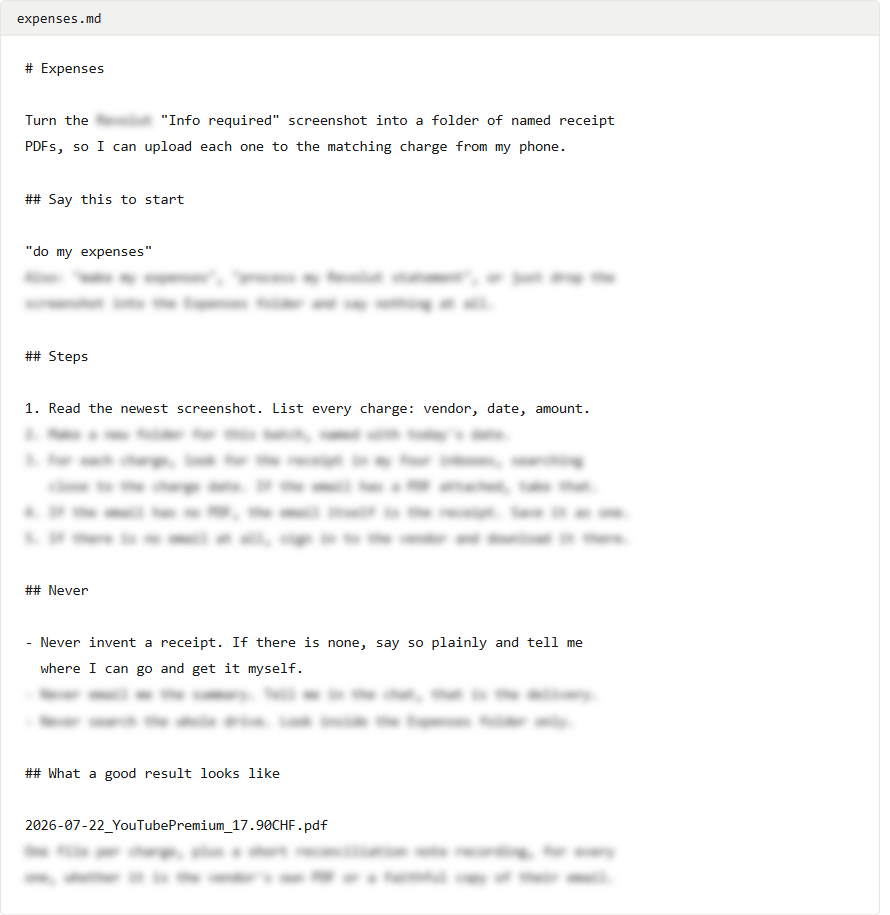
A real one, with most of it blurred. Tap to see it larger.
Write it for someone on their first morning, not for someone who
already knows you. The boring details are the entire job. Which
inbox. Which folder. What to do when something looks wrong.
Let me show you another real one
Every weekday at six in the morning, an email arrives telling me
which proposals are still outstanding, how long each one has been
waiting, and which offers expire this month.
That is not software. It is a text file that says: read this one
document, work out how many days each item has been sitting
there, flag anything past thirty days, write it as a short email,
send it to me.
I wrote it in about ten minutes. It has run every weekday since.
The two rules you should not forget
First: decide where it stops and asks you.
Mine is simple. My agents may write emails. They may not send
them to anyone except me. Anything meant for another human
becomes a draft that waits for me to read it in the Drafts
folder.
I hear this from many of you: what if it does something on my
behalf that I would never have done?
It cannot, if you wrote the line.
Second: when it gets something wrong, fix the file. Do not argue
with the chat.
Every mistake becomes one new sentence in the instructions. Tell
the AI to avoid this mistake next time by adjusting the
instructions. It is like a permanent learning curve.
Where to start
One. Just one.
The task you resented doing this morning. Open a blank document
and write down how you do it, as if you were handing it to a new
colleague who starts tomorrow. Or record yourself talking about
it and give it to Claude Code, Codex or any agentic AI tool. Then
ask it to make a skill of it, so you can reuse it time after
time.
For me, one of the first ones was the agent that talks in my
voice. I was tired of asking for drafts and getting back stuff
that a stranger wrote, so one evening I wrote down how I write
and speak (and had some sample comms analysed by the AI) and
handed it over.
I also have more complex agents, where there is more content, but
still, everything is done in English as a coding language. If you
want to see what one of these looks like when it is finished and
pointed at real people, Coach Tünde is exactly that. Same method.
Instructions written in English, a gate where the judgment has to
stay mine. Bring it a real career question and see what it asks
you back.
I Do Not Know How to Keep Up
That sentence comes up in almost every conversation I have at the
moment. Senior people, good at their jobs, saying it quietly and
slightly embarrassed.
I have said it myself. Not about AI. At my desk, after maternity leave, certain that
everyone had moved on without me.
I was wrong about what was happening. It felt like falling
behind. It was actually that the job had changed shape, and I was
still grading myself against the old shape.
More hours would not have fixed that. Nothing would have, except
someone telling me I was failing a standard that no longer
applied.
I think that is exactly what is happening to people with AI right
now.
Look at how we measure ourselves. Tools tried. Models named.
Whether we read the thing everyone posted about on Tuesday. It is
a scoreboard nobody can win, and it does not describe anyone’s
actual job.
I see a big reason why people feel they are behind with AI. They
have never written down what their work actually consists of.
Like flying blind in their own work. So every new announcement
feels like it might be aimed at them, and there is no way to
check.
Keeping up with progress also means knowing where you stand right
now. Only then can you take the next step. And yes, it is
complex, it is not standard, but you can break things down into
elements. Like I did with my expenses reconciliation, or with
creating comms.
From Wednesday: #OpenDoorInnovation
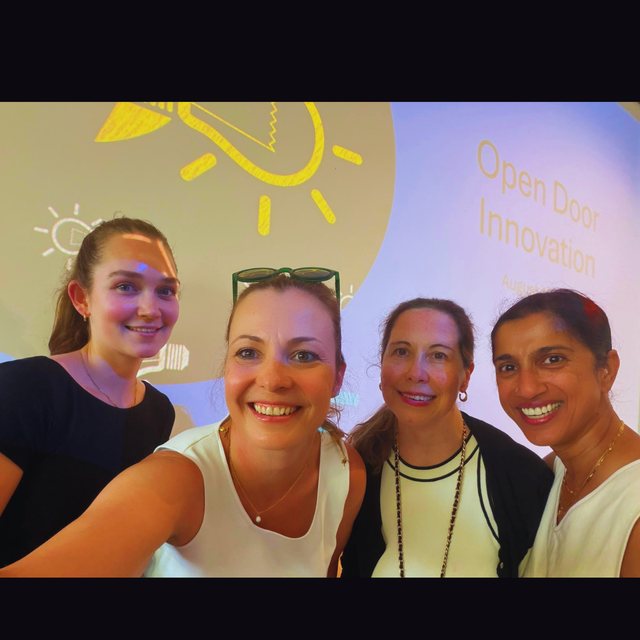
On Wednesday evening we hosted the #OpenDoorInnovation meetup in
Zürich (more about this here), at the inspiring location of
Implement Consulting. Gitanjali and I have been organizing this
two to three times a year for people working in and around
corporate innovation, always having a speaker to spark ideas.
This time Heather Pace Clark spoke about innovation ecosystems
and crisis as a catalyst, including which technologies beyond AI
are worth watching from the latest WEF Innovation Report. Look
out for our next events, would love to have many curious minds
there.
Before I Go
Both articles come back to the same thing.
Write down how you do the work. Then decide what you are handing
over and what stays yours.
The file is where you give away the work. The rules inside it are
where you keep the judgment.
You do not need twenty-seven. You need one, and one afternoon.
Which job would you write down first? Hit reply and tell me, I
read every answer.