|
Time to read: 5 minutes
In this edition:
-
The Platform I Stopped Paying For
-
What If You Do Not Run a Business? (including a useful prompt)
-
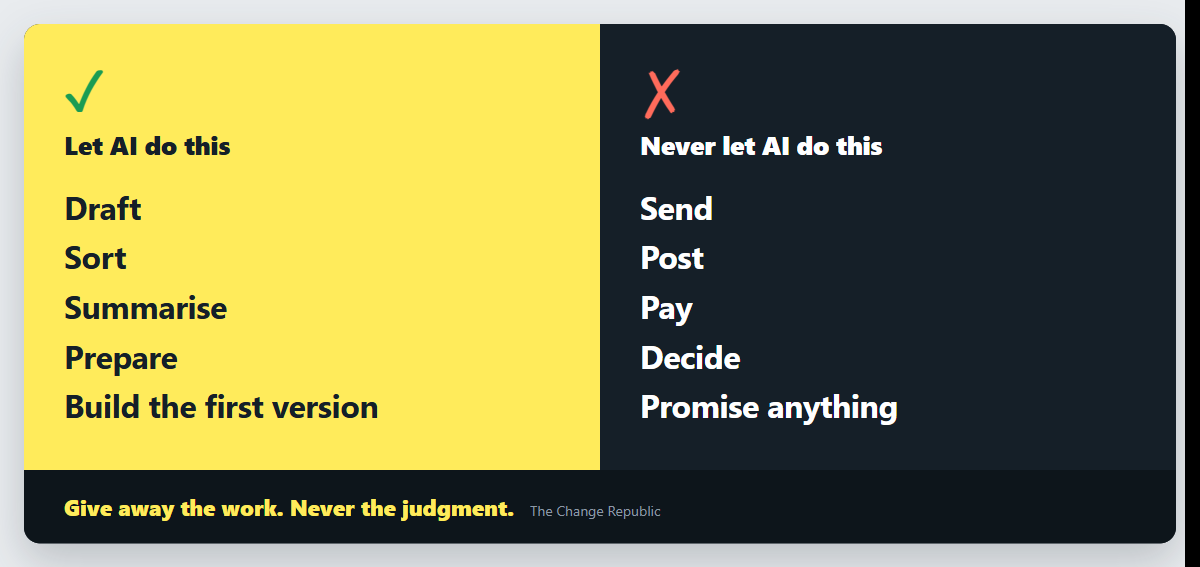
The Two Rules Your Team Needs
Speakers Wanted: Claude for Leaders
We are looking for speakers for Claude for Leaders in Zürich.
Non-technical speakers, non-technical audience. If you use Claude
in your own work and have a real story from inside your company,
send me a message.
The Platform I Stopped Paying For
It costs $180 a month. Just over $2,000 a year.
I want to be fair to it. I chose it deliberately, it did the job
for a whole year, and one login held everything. Convenience is
what I was paying for, and for a long time it was worth the money.
But not in 2026. Sometimes I still hardly believe I can vibe code
so many things. And no, I am no software developer. For me Python
is (and will remain) a scary reptile.
What changed is that I could build the pieces myself. I
wrote about it on
LinkedIn when it happened, if you want the short version.
The word for that now is vibe coding. You describe what you want in
ordinary language, the AI writes the software, and you judge the
result instead of reading the code. Andrej Karpathy gave it the
name in early 2025. I have never programmed. I have described
things, in English, the way I would explain them to a new
colleague.
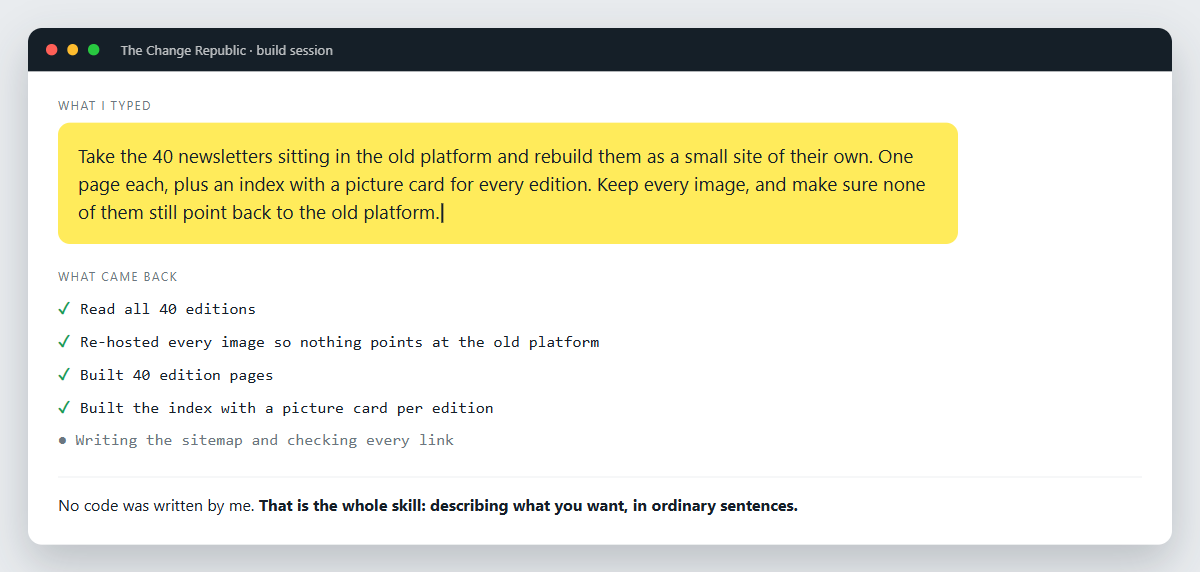
What I typed to rebuild the newsletter archive.
So at the end of June, I opened a new chat in Claude Code and I
described what I actually needed: where my subscribers live and how
they get labelled, what a sign-up page has to do, and the one that
kept me awake, what happens to the newsletters I had already sent.
There were 36 of them sitting inside a platform I was about to
cancel. Two years of writing, in someone else’s box.
They are now a small site of their own. You will find them on my
newsletter page,
under Past editions. All (now) 40, one page each, with a picture
card index. It took some hours. You are reading number 41.
The STAR career transition course, which combines online modules
with coaching, moved to its own page as
well, with the videos hosted elsewhere and a payment link at the
end.
Now the part I would not want you to skip.
I did not build everything, and I would not advise it. Getting an
email to land in more than a thousand inboxes rather than in spam
folders is a hard, unglamorous problem that other people have spent
years solving. So I bought it. A dedicated email service, about $40
a month, and it is what put this email in front of you. Payments
and video hosting are bought in too.
The rule I gave myself was to buy the hard parts and build only the
glue between them.
The bill went from $180 to $40. That is $1,680 a year saved, which
is nice, and it is also definitely not the only thing I got out of
this experience.
The bigger one is that I can change my mind now. When I want a new
feature, software, app, or dream anything, I write a few sentences
and it exists that evening. I have stopped waiting to see whether a
company somewhere puts the feature I need on its roadmap.
What If You Do Not Run a Business? (Including a Useful Prompt)
Most of you do not run a business. You have a job, a team, a
manager, and an IT department with a view on all of this. So the
story above can read like something that only applies to founders.
I think the same move is available to you, in a smaller and more
useful form.
Vibe coding again, in plain terms: you write down what you want,
the AI builds it, and you check whether it is any good. There is no
course to take and no language to learn. The skill is describing
your own work clearly, which is the part almost nobody has ever
done.
You usually need an agentic environment, like Code in Claude or
Codex in ChatGPT. These are included in your Pro (or higher tier)
subscription, starting at about $20 a month.
Things people around me have built this way in an evening.
At work:
-
The weekly report you assemble by hand from three exports
-
A one-page comparison table out of six sets of interview notes
-
A tracker for a project where the official template never quite
fitted
-
A tool that reads a job advert and tells you what is missing from
your CV
-
A running record of your own work through the year, so the December
self-assessment takes an hour instead of a weekend
Outside work, which is where most of the monthly fees actually
sit:
-
A morning digest of the five sources you genuinely follow, instead
of the three paid newsletters you skim
-
Something that reads an insurance policy, a rental contract or a
pension statement and tells you in plain words what it actually
says
-
Your own money in one view, built from the exports your bank
already gives you
-
A training plan that adjusts to how the week actually went, instead
of the fitness app you pay for every month and open twice
-
The family holiday plan, with flights, bookings and the packing
list in one place, and the booking pages opened and ready if you
are relaxed about entering the card details yourself
-
A revision helper for a teenager preparing for exams. We have built
countless MAP tests and similar interactive tests in html for my
son. Well, my AI agent, Klaus did.
Look at the subscriptions on your phone. That is a good starting
list.
The limit, and I mean this seriously. Everything you build at work
stops at your company’s data. That means client names, personal
data, anything under an NDA, and anything pulled out of an internal
system. Build around your own work, keep confidential material out
of it, and tell your IT team what you are doing before you build
it. Describe exactly what the thing touches. That conversation is
short when the honest answer is nothing sensitive.
If you do not know where to start, use this. Copy it, paste it into
Claude or ChatGPT, and answer honestly.
|
I want to find things in my work and my personal life that I
could build myself with AI, instead of paying for them or
doing them by hand. Ask me one question at a time and wait
for my answer before you ask the next one. Tailor your
questions around everything you know about me.
Ask me:
1. What do I do every week that repeats and takes me more
than twenty minutes?
2. What do I pay for every month, at work or privately, and
what does each one actually do for me?
3. What do I keep in spreadsheets, notes or my head because
no tool fits the way I work?
4. What have I stopped asking for because it seemed too small
to be worth a request?
5. What part of my job would I be embarrassed to admit still
takes me a whole morning?
Then give me five ideas, ordered by how quickly I could build
them. For each one, tell me what it would replace, roughly
how long it would take a beginner, and what could go wrong.
Leave out anything that would need my company's internal
systems or confidential data. I would use an agentic tool
like Claude Code or ChatGPT Codex, so focus on use cases that
I can do with these.
|
It will come back with more than you can do. Start with the one
that irritates you most. That is the one you will actually finish.
Doing this on your own? If you want a read on where you and your
team genuinely stand with all of this, rather than where the noise
suggests you should be, the assessment takes five minutes.
|