|
|
The economy grows, but not your salary. And who gets the money instead.
|
|
|
|
|
042: What AI Does to Your Salary
|
|
|
|
|
Your pay might not go up for the rest of the decade. And the
economy will be doing great.
|
|
|
|
|
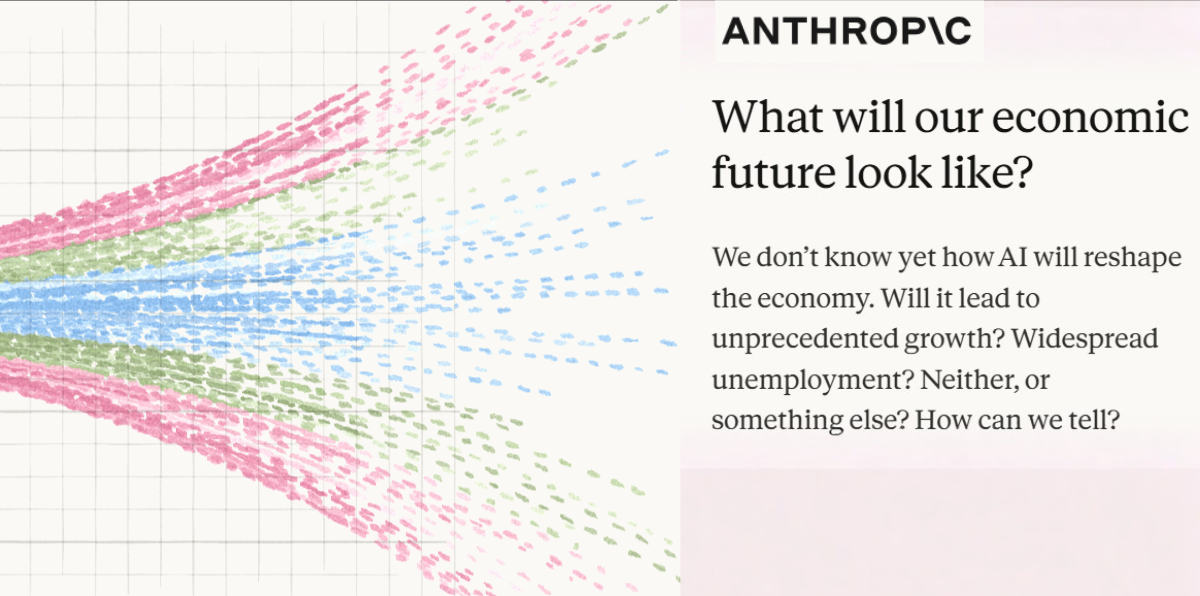
That is the line I could not get past last week, reading
Anthropic's new
model of the economy up to 2030. Here is the link.
(Anthropic makes Claude. Yes, the AI company modelled what AI does
to your salary.)
|
|
|
|
|
Time to read: 7 minutes
In this edition:
1. Twice the Growth, No Raise
2. Who Gets the Money, and Who Moves
3. Who Keeps the Job
|
|
|
|
Speakers Wanted: Claude for Leaders
|
|
|
|
|
We are looking for speakers for Claude for Leaders in Zürich.
Non-technical speakers, non-technical audience. This time one
condition: your company is based in Zürich or the area, because the
evening is in person. If you use Claude in your own work and have a
real story from inside your company, send me a message.
|
|
|
|
Twice the Growth, No Raise
|
|
|
|
|
Imagine it is 2030. The economy is growing twice as fast as it does
today. Faster than in the best year of the dot-com boom.
And your salary is not growing.
That is the middle of the three scenarios in the model, the one
most people in Anthropic's survey expect.
In it, AI can do about half of all knowledge work. Companies use it
for a good part of that. Double growth is happening.
For knowledge workers, pay keeps growing at the usual slow pace. AI
adds nothing to it.
Everyone else gets the usual raises, plus around 6 percent on top.
Knowledge worker, in the report, means management, professional,
sales and office jobs. Nearly two out of three people with a job.
Most of the people reading this. Understand: if you have a job that
you do from behind a computer, you don't benefit from the huge
economic boom.
And no, nobody gets fired in this picture. Well, almost nobody.
Unemployment for knowledge workers goes up by about 1.5 points. You
keep your job. Just the value of your job doesn't grow.
At this point, you may ask: so where does the money go?
To the owners of the machines. Four cents of every dollar move from
pay to capital in four years. That is nearly the whole shift the US
saw in the forty years after 1980. (I read that twice.)
One more thing. None of this shows yet. The model says almost all
of it starts after 2027. Right now, it's the calm before the storm.
(For the record, the scary scenario: knowledge workers earn 11.5
percent less, and almost one in five of them is out of work.)
In case you are wondering how Anthropic came up with this: they
asked almost 11,000 Americans what they expect AI to be able to do
by 2030, how much people will use it, and how fast someone finds a
new job after losing one to AI. Their answers went into a model
built by economists and checked by 18 outside economists. Remember,
they know exactly who uses AI for what. The authors say it
themselves: these are not predictions. Fair enough. I still cannot
get past that salary line.
|
|
|
|
Who Gets the Money, and Who Moves
|
|
|
|
|
If knowledge workers do not get the raise, who does?
Electricians. Construction workers. Caretakers. Entertainers.
Anyone whose work AI cannot do.
The report's own example: when AI draws up building plans and gets
the permits through faster, more buildings get built. More
buildings, more construction workers, higher pay for them.
So some people change sides. Knowledge jobs shrink by about 4
percent, everything else grows by about 5 percent.
And that move is hard. The economists say it in one line: a
software engineer does not easily become an electrician. Finding a
new job takes long already now, even if you just want to continue
what you did before. In Switzerland, for senior roles often 9-12
months. Now add to that the time for transitioning your
profession...
Another part I find especially interesting.
Of the tasks AI touches, three quarters get taken over by AI
completely. One quarter stays with a person, working with AI
(human-in-the-loop). And for every four tasks handed over, one new
task appears that only a person can do.
Pay follows the tasks that stay with people. Checking. Deciding.
The new stuff. The ones that need you to be a human.
If everything you do today can be handed over to AI, your job goes
with it. Then you are the one looking for new work.
(You have heard me say it on stage: give away the work, never the
judgment. Now there is a wage model behind it.)
Oh, and my favourite number in the whole thing.
The knowledge workers in the survey were asked how much of their
own working time AI could do by 2030. Typical answer: 27 percent.
The same people, shown a list of eight normal office tasks (emails,
bookkeeping, a tax return, a contract, a piece of software), said
AI could do 71 percent of them.
Always somebody else's job.
|
|
|
|
|
I cannot tell you which scenario arrives. Nobody can.
What I can tell you is who stays on the knowledge side, in every
one of them.
The model runs on averages. It has no idea who ends up with the
flat pay and who does not. But the logic inside it is clear. The
people who stay are the ones who hand the routine work to AI and
keep the checking, the deciding and the new tasks for themselves.
In other words, the ones who are good enough with AI to know what
to hand over and what to keep.
That is a skill. And very few of us have ever measured it.
It is about more than getting faster, by the way. Speed is the
boring part. The people who are good with AI do things they could
not do before. They build a tool for their team in an afternoon.
They test a business idea over a weekend instead of writing a
proposal about it. They find a cost nobody had questioned, or a
service nobody had thought to offer. New work, new revenue, new
ways of running the business. That is where the pay follows.
So, one question. How good are you with these tools, honestly? And
can you change your mindset and work differently?
I built a short check for exactly that. Ten statements about your
own use of AI, two minutes, and honestly a bit of fun.
Your result lands in your inbox, with a plain reading of where you
stand and what to do next.
|
|
|
|
|
If the results show a gap you want to close, that is the work I do
one on one with a select group of leaders or business owners, that
are turning their ways of working upside down (for the better).
Someone I started working with recently just got a chief of staff,
and began changing how her business runs after the first two hours
we spent together.
I only have very limited availability for this. Book a short
call if you want to apply.
|
|
|
|
|
P.S. The model is public and you can play with it. Put in your own
assumptions and watch the salary line move. The link is at the top.
|
|
|
|
|
How can we work together?
|
|
|
|
|
Did you miss our last newsletters?
Inboxes can get a little crazy, right? Just in case you missed
them, here are the links to
our previous newsletters:
|
|
|
|
The Change Republic
Rötibodenstrasse 34, Wädenswil
Switzerland
|
|
You received this email because you signed up on our website
or made a purchase from us.
|
|
|
|
|
|

|
|
|